In your browser · and on your Mac

Describe a song. Then produce it for real.

Tell Moziko what you want, in a few words. About a minute later you’re listening to a full song, drums, bass, chords and melody, written for you. Then change any note, sing over it, or ask the AI Producer for anything in plain English.

Your first song in about a minute No card to try it Browser, or Mac (macOS 13+)
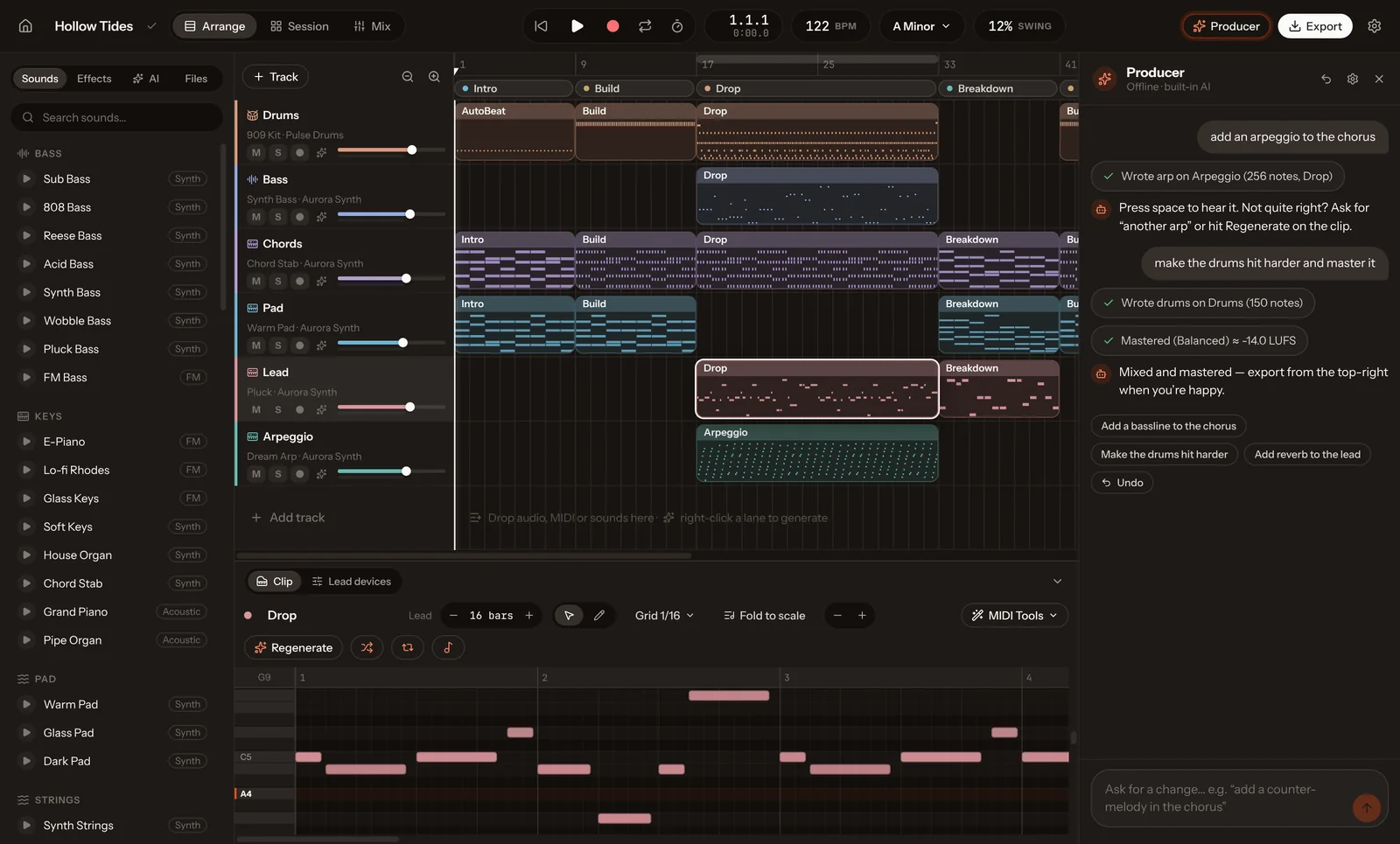
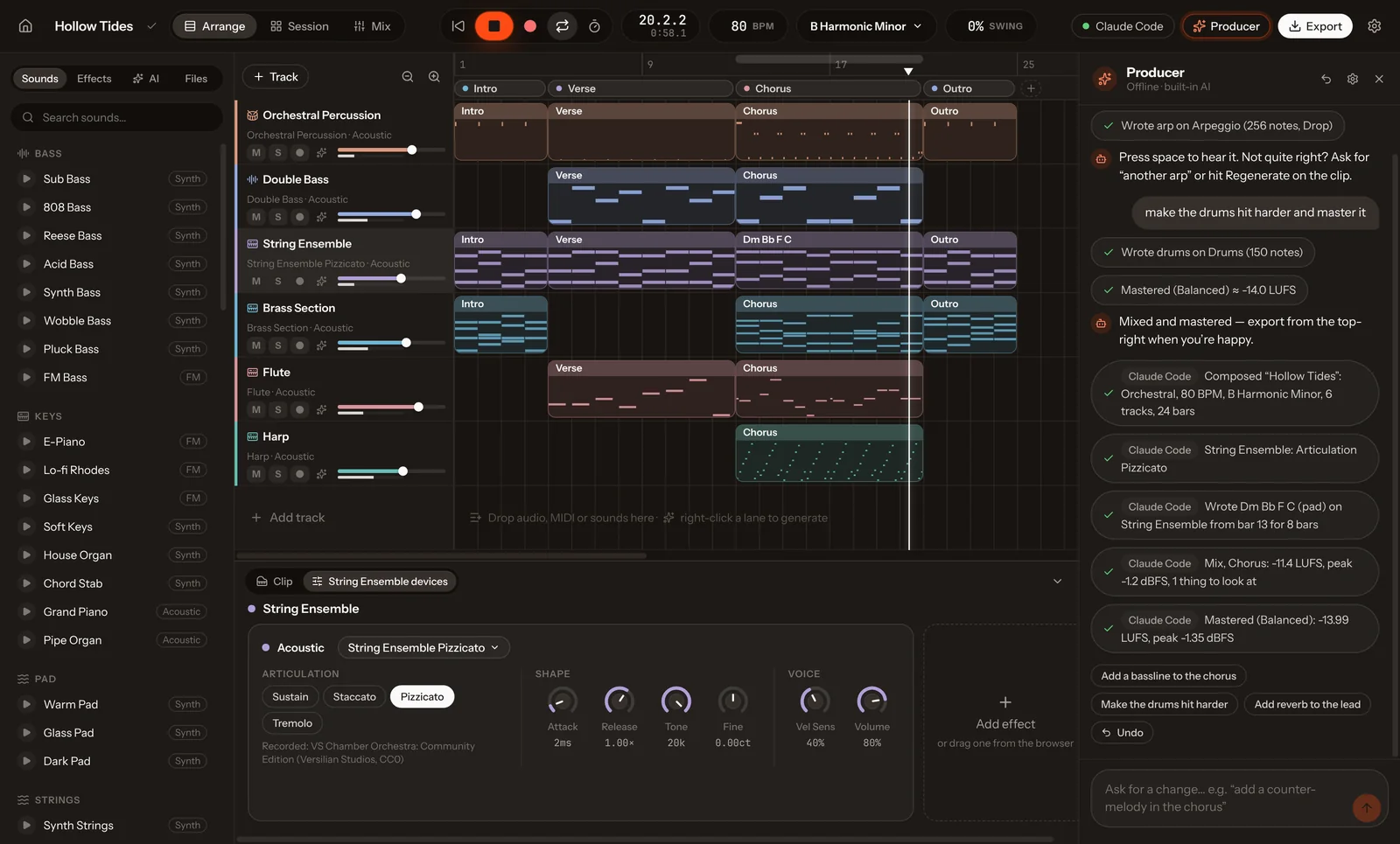
Arrangement view · a song made from one sentence
Moziko's arrangement view with drums, bass, chords, pad, lead and arpeggio tracks laid out in sections, and the AI Producer panel on the right
Showcase

Every sound on this page came out of Moziko.

Deep house, drum & bass, future bass, trap, afrobeats and orchestral pieces, composed in the app by Claude working through the MCP server, then mixed and mastered with Moziko’s own tools. Press play, and open “How it was made” to see each step.

Cutlass at Dawn
Adventure Score100 BPMD minor
0:00 / 1:34
How it was made

Composed note by note in Moziko by Claude, starting from the prompt “a swashbuckling pirate-adventure theme: galloping 6/8 strings in D minor, heroic horns, brass stabs and timpani, building to a full-orchestra climax”.

  1. New song at 100 BPM in D minor, each beat a dotted quarter so everything gallops in triplet eighths; sections Intro 4 · Theme 8 · Theme 2 · 8 · Storm 8 · Climax 8 · Ending 2
  2. Cello Section Staccato and Double Bass Staccato: a non-stop galloping ostinato on the chord roots (Dm – Bb – F – C – Dm – Gm – A – Dm), the cellos alone in the Intro and crescendoing in
  3. French Horn: an original heroic theme over the gallop; Trombone doubles it an octave down from Theme 2, Violin Section takes it an octave up, and the Climax puts all three together
  4. Viola Section Staccato and Trumpet Staccato: chord stabs on the off dotted-quarters; Violin Section Tremolo shimmering under the first Theme and the Climax
  5. Storm: Trombone and Tuba Staccato growl a call on Gm and Dm, String Ensemble Staccato answers with rising arpeggios, a snare roll and a Timpani Roll on A pull into the Climax
  6. Timpani on the chord roots with pickups, Orchestral Percussion bass drum, galloping snare, crashes, a cymbal swell into the Climax and a gong on the last chord
  7. Ending: two A7 hits and a final D minor chord for the whole orchestra, no fade; mastered with Punchy to −12 LUFS

Listening: The gallop never stops: cellos and basses hammer triplet eighths under every section, so the theme, the brass stabs and the timpani pickups all ride the same 6/8 swing, and the orchestra keeps adding layers until the two A7 hits and the final D minor chord.

Cello Section StaccatoDouble Bass StaccatoViola Section StaccatoFrench HornTromboneTuba StaccatoTrumpet StaccatoViolin SectionViolin Section TremoloString Ensemble StaccatoTimpaniTimpani RollOrchestral Percussion
Monsoon Circuit
Drum & Bass174 BPMF minor
0:00 / 1:36
How it was made

Made by Claude over MCP.

  1. new_project “Monsoon Circuit”, 174 BPM, F minor; set_sections Intro 16 · Build 8 · Drop 16 · Breakdown 8 · Drop 2 16 · Outro 4
  2. add_track: a 909 “Beat” bus, an Acoustic Kit “Break” layer, Reese Bass + Sub Bass, Dark Pad, FM Bell motif, Pluck stabs, noise riser
  3. set_instrument: Reese with 22-cent detune, 3-voice unison and a slow filter LFO; add_effect saturator + chorus on it, 6 s reverb on the pad
  4. create_clip: two-step beat (kick 1 & the and-of-3, snare 2 & 4, ghost snares, tom fills) under an Amen-style break layer high-passed at 320 Hz
  5. create_clip: atmospheric intro — Fm9 – Dbmaj7 – Bbm9 – Cm7 pad with the break fading in at bar 9 and a dotted-8th-delayed bell motif
  6. create_clip: two-bar reese phrases with octave flicks and fifth/third pickups, doubled by the sub; a variation in Drop 2
  7. create_clip: off-beat pluck stabs answering the snare, snare rolls and risers into each drop
  8. analyze_audio found the drum bus 14 dB over the reese and the pad bed louder than the motif → beat −3 dB, reese +9 dB, pad −3 dB, break/stabs/motif up
  9. analyze_audio: breakdown dominated by the snare roll → softer roll velocities
  10. master punchy, export −14 LUFS

Listening: The first drop render measured −11.1 LUFS with the drum bus at −20 LUFS and the reese at −34.5 LUFS (no band of its own); after rebalancing the drums and reese sat within 2 dB of each other and analyze_audio reported no problems. In the breakdown the snare roll read 9 dB over the motif and was softened.

909 KitAcoustic KitReese BassSub BassDark PadBellPluckWarm Pad (noise riser)
Paper Satellites
Future Bass150 BPMEb major
0:00 / 1:45
How it was made

Made by Claude over MCP.

  1. new_project “Paper Satellites”, 150 BPM, Eb major; set_sections Intro · Verse · Build · Drop 16 · Breakdown · Build 2 · Drop 2 · Outro (64 bars)
  2. add_track: Trap Kit (kick on its own track), Sub Bass, Supersaw chords, Grand Piano, Supersaw lead, FM Bell, Glass Pad, noise riser
  3. set_instrument: 7-voice supersaw with an 85 ms attack so every chord hit re-swells after the kick (sidechain-style pump)
  4. create_clip: Abmaj9 – Bbadd9 – Cm9 – Eb/G | Abmaj9 – Bbadd9 – Cm9 – Fm9 Bbsus4 as syncopated supersaw chops
  5. create_clip: an 8-bar lead hook, doubled two octaves up on the bell and an octave down on the Grand Piano in Drop 2
  6. create_clip: half-time drums (kick 1 + the and-of-3, clap+snare on 3, triplet hat rolls), a doubling snare roll into each drop
  7. duplicate_track: split the chords into Saws L / Saws R panned ±0.75 with different detune after analyze_audio reported a nearly mono drop (corr 1.0)
  8. analyze_audio: chords buried (−35.8 LUFS) and sub-heavy → chords +5 dB per side, sub −2 dB, kick +3 dB, lead +6 dB
  9. analyze_audio: build louder than the drop and a 500 Hz piano build-up in the breakdown → softer roll and saw pulses, piano EQ −3.5 dB at 450 Hz
  10. master punchy, export −14 LUFS

Listening: The first drop render read −16.9 LUFS, nearly mono (correlation 1.0) and sub-heavy, with the chords at −35.8 LUFS; after splitting the chords into a wide L/R pair and rebalancing, it read −14.4 LUFS at correlation 0.92 with no warnings. The build was louder than the drop and the breakdown had a +4.3 dB piano bump at 500 Hz; both were fixed.

Trap KitSub BassSupersaw Lead (chords, ×2)Supersaw Lead (mono lead)Grand PianoBellGlass PadWarm Pad (noise riser)
Smoke & Satin
Deep House122 BPMA minor
0:00 / 1:45
How it was made

Made by Claude over MCP.

  1. new_project at 122 BPM in A minor (titled with set_song); set_sections Intro 8 · Groove 8 · Drop 16 · Breakdown 8 · Drop 2 8 · Outro 4
  2. add_track ×9: separate Kick, Tops and Perc drum tracks (909 + Afro kits), Sub Bass, Chord Stab, Pluck, E-Piano, Warm Pad, a noise riser
  3. set_instrument: turned the Pluck into a band-passed, gliding mono “vocal chop”; noise riser with a 4 s filter sweep
  4. create_clip: drum grids with hand-placed shuffle (off-16ths late by ~20 ms), conga/clave groove, clap roll into Drop 2
  5. create_clip: Am9 – Dm9 – Fmaj9 – Em11 as rootless stabs (x..x..x....x..x.), last stab pushing the next chord
  6. create_clip: off-beat rolling sub with 16th ghost notes and octave flicks
  7. create_clip: two-cell chop hook sequenced down the progression; E-Piano plays it an octave down in the breakdown
  8. analyze_audio found the kick buried and the sub too heavy → kick +6 dB, F/E bass roots up an octave, stabs −1 dB with EQ −3 dB at 350 Hz
  9. analyze_audio found the hook 15 dB under the stabs → opened its band-pass and lifted it 11 dB in two passes
  10. analyze_audio found a 500 Hz build-up in the breakdown → EQ −3.5 dB at 500 Hz on the E-Piano, −2.5 dB on the pad, hook moved up an octave
  11. master punchy, export −14 LUFS

Listening: First pass: the drop measured −16.9 LUFS with the kick 4 dB under the bass, the chop hook at −46 LUFS and a sub-heavy warning; after rebalancing it measured −14.1 LUFS with no findings. The breakdown flagged a +5 dB low-mid bump at 500 Hz from the E-Piano, cleared with EQ cuts and by moving its hook up an octave.

909 KitAfro KitSub BassChord StabPluck (band-pass chop)E-PianoWarm PadWarm Pad (noise riser)
Obsidian Hours
Trap142 BPMF minor
0:00 / 1:30
How it was made

Made by Claude over MCP, starting from the prompt “dark trap with eerie bells, hard 808 glides and rolling hi-hats”.

  1. create_song “dark trap with eerie bells, hard 808 glides and rolling hi-hats”, short form, then set_sections to Intro 8 · Hook 16 · Verse 8 · Hook 2 16 · Outro 4 and cleared the generated clips
  2. write_chords: Fm – Dbmaj7 – Bbm – C (harmonic-minor V) on Dark Pad, two bars each
  3. create_clip: 8-bar bell hook in 3-3-2 rhythm that lands on E natural over the C chord
  4. add_track Grand Piano: the same motif an octave down plays the intro alone, then doubles the bells in Hook 2
  5. set_instrument 808 Bass: glide 0.09 s, decay 2.2 s, drive 0.32, pitch punch 14 st; 808 line follows the kick and slides into each new root
  6. create_clip drums by hand: half-time snare+clap, 8th hats with 1/16-triplet, 1/32 and triplet-8th rolls every second bar, open hats in Hook 2
  7. analyze_audio on Hook 2: bells 7 dB under the drums and 'sub-heavy' → bells +7 dB, piano +5 dB, kick low shelf 2.5→0.5 dB, 30 Hz high-pass on 808 and kick
  8. analyze_audio flagged a +4.3 dB low-mid bump at 500 Hz → EQ cuts on bells (−3.5 dB @ 450 Hz), piano (−3 dB @ 400 Hz) and pad (−2 dB @ 350 Hz)
  9. master punchy, 808 −1.5 dB more, export −14 LUFS

Listening: First pass of Hook 2 had the bells at −26 LUFS against −19 for the drums and a sub-heavy warning; after the level moves the bells sit at −19 LUFS, then a +4.3 dB low-mid bump at 500 Hz went down to +2.9 dB with three EQ cuts, and Hook 2 came back with 'no obvious problems'.

Trap Kit808 BassBellGrand PianoDark Pad
Lekki Sundown
Afrobeats105 BPMD major
0:00 / 1:34
How it was made

Made by Claude over MCP, starting from the prompt “bouncy afrobeats with log drum bass, marimba hook and warm rhodes chords”.

  1. create_song “bouncy afrobeats with log drum bass, marimba hook and warm rhodes chords”, then set_song swing 14 % and set_sections Intro 4 · Verse 8 · Hook 8 · Bridge 8 · Hook 2 8 · Outro 4
  2. set_instrument: turned the Sub Bass into a log drum (square overtone, 9-semitone pitch drop, 0.42 s decay, drive 0.3)
  3. create_clip: Gmaj9 – A6/9 – F#m7 – Bm9 on E-Piano, hand-voiced around a held F#4, sustained in the intro, comping in the verse, syncopated stabs in the hooks
  4. create_clip: 8-bar Concert Marimba hook in off-beat 16th pickups, answered by a Kalimba counter-figure in Hook 2
  5. create_clip drum step grids on the Afro Kit: 3-3-4 rim, accented 16th shaker, conga calls, claps and hats only in the hooks, cowbell for the peak
  6. Bridge for contrast: kick and clap drop out, the log drum goes sparse and a recorded Flute sings a long line over sustained Rhodes
  7. analyze_audio: log drum at −30 LUFS under −22 drums, kalimba/pad inaudible, 500 Hz build-up and a 'nearly mono' verse → log drum +7 dB, Rhodes chorus + pan, marimba EQ dip at 520 Hz, widePad chain on the pad
  8. Second listen: Rhodes was louder than the hook → Rhodes −3.5 dB, marimba +2.5 dB, flute and kalimba up
  9. master punchy, export −14 LUFS

Listening: First pass of Hook 2 measured the log drum at −30 LUFS against −22 for the drums, flagged a +4.8 dB build-up at 500 Hz and called the verse nearly mono; after the level, EQ and chorus moves every section reported 'no obvious problems' with the marimba hook on top (−18.5 LUFS) and the flute leading the bridge.

Afro KitSub Bass (log drum design)E-PianoConcert MarimbaKalimbaFluteWarm Pad

All 19 tracks and how they were made

AI · Song Starter

From one sentence to a full arrangement.

  1. Describe it

    Genre, mood, tempo, key and instruments: “dreamy lo-fi with rhodes in F minor, 80 bpm”, “piano ballad with cello”, “no drums”. Or pick one of 17 genres.

  2. Get a song, not a loop

    Drums, bass, chords, pad, melody and arpeggio that share one chord progression, laid out as intro, verse, chorus, bridge and outro, with matching Session scenes.

  3. Make it yours

    Everything is editable MIDI on real instruments. Change a chord, redraw the hook, swap the kit, or ask the Producer to do it.

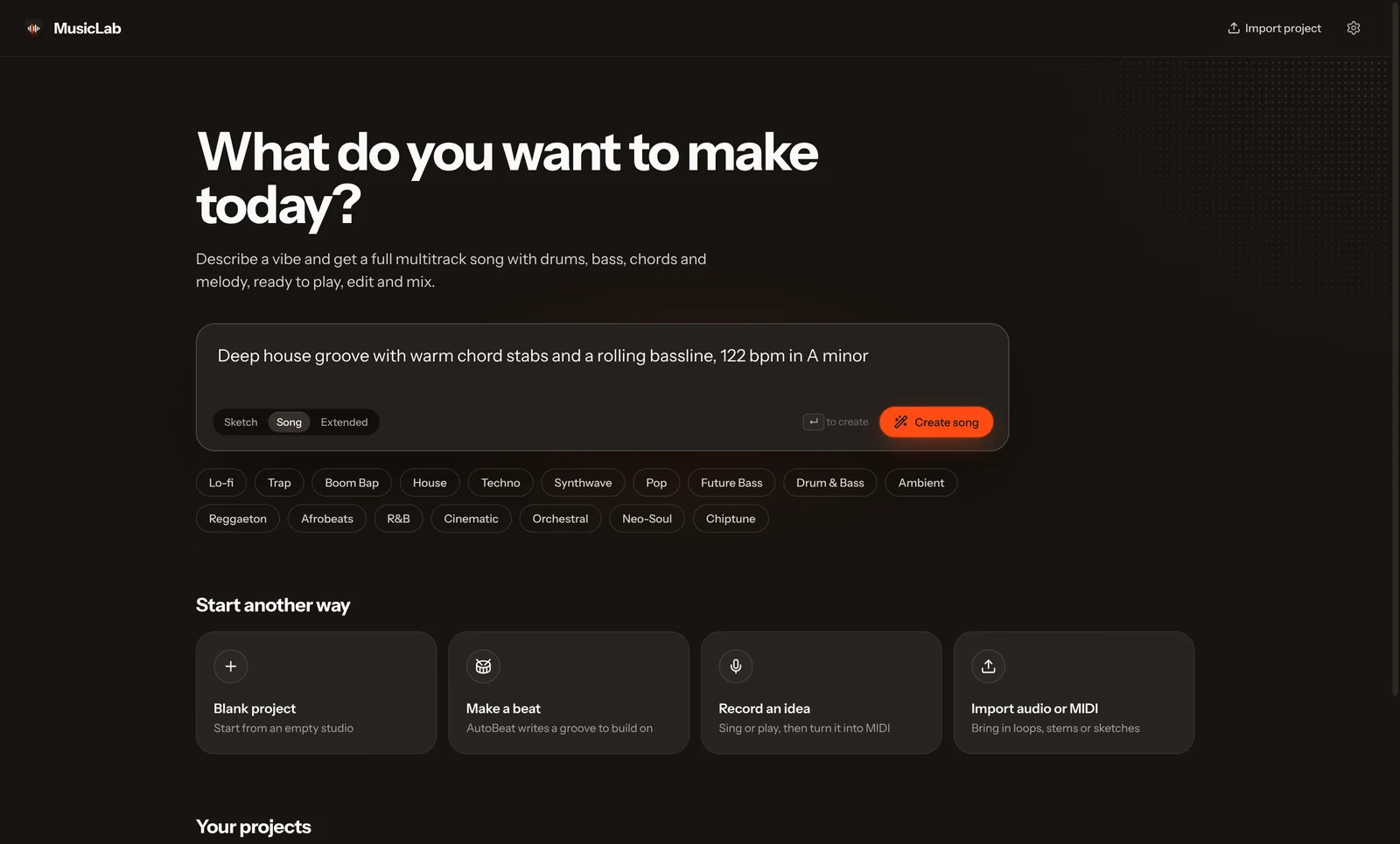
Home
Moziko home screen with a prompt box reading “Deep house groove with warm chord stabs and a rolling bassline, 122 bpm in A minor”, length options and genre chips
AI · Producer

Ask for changes the way you’d ask a producer.

The Producer edits the open song with Claude, built in, so open-ended requests like “write a counter-melody for the second chorus” just work. Each song keeps its own conversation. Every change is one undo step.

All the AI features
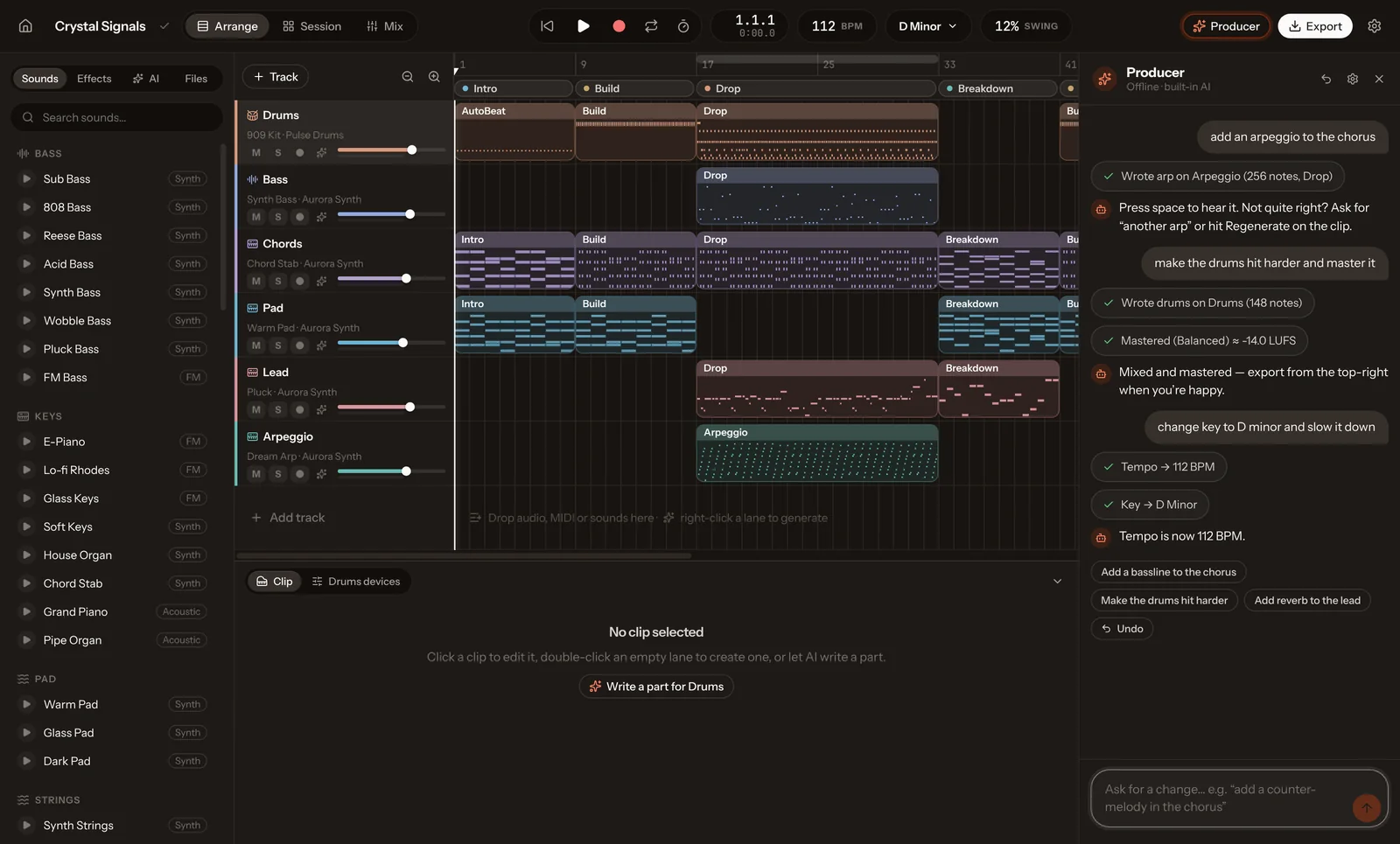
add an arpeggio to the chorus
Wrote arp on Arpeggio (256 notes, Drop)
Press space to hear it. Not quite right? Ask for “another arp” or hit Regenerate on the clip.
make the drums hit harder and master it
Wrote drums on Drums (148 notes)
Mastered (Balanced) ≈ −14.0 LUFS
Mixed and mastered — export from the top-right when you’re happy.
change key to D minor and slow it down
Tempo → 112 BPM
Key → D Minor
Studio

A real studio underneath.

The AI gets you started; the studio is where you finish. Session and Arrangement views, a piano roll with Live 12-style MIDI tools, a drum sequencer, synths, effects, a mixer and recording.

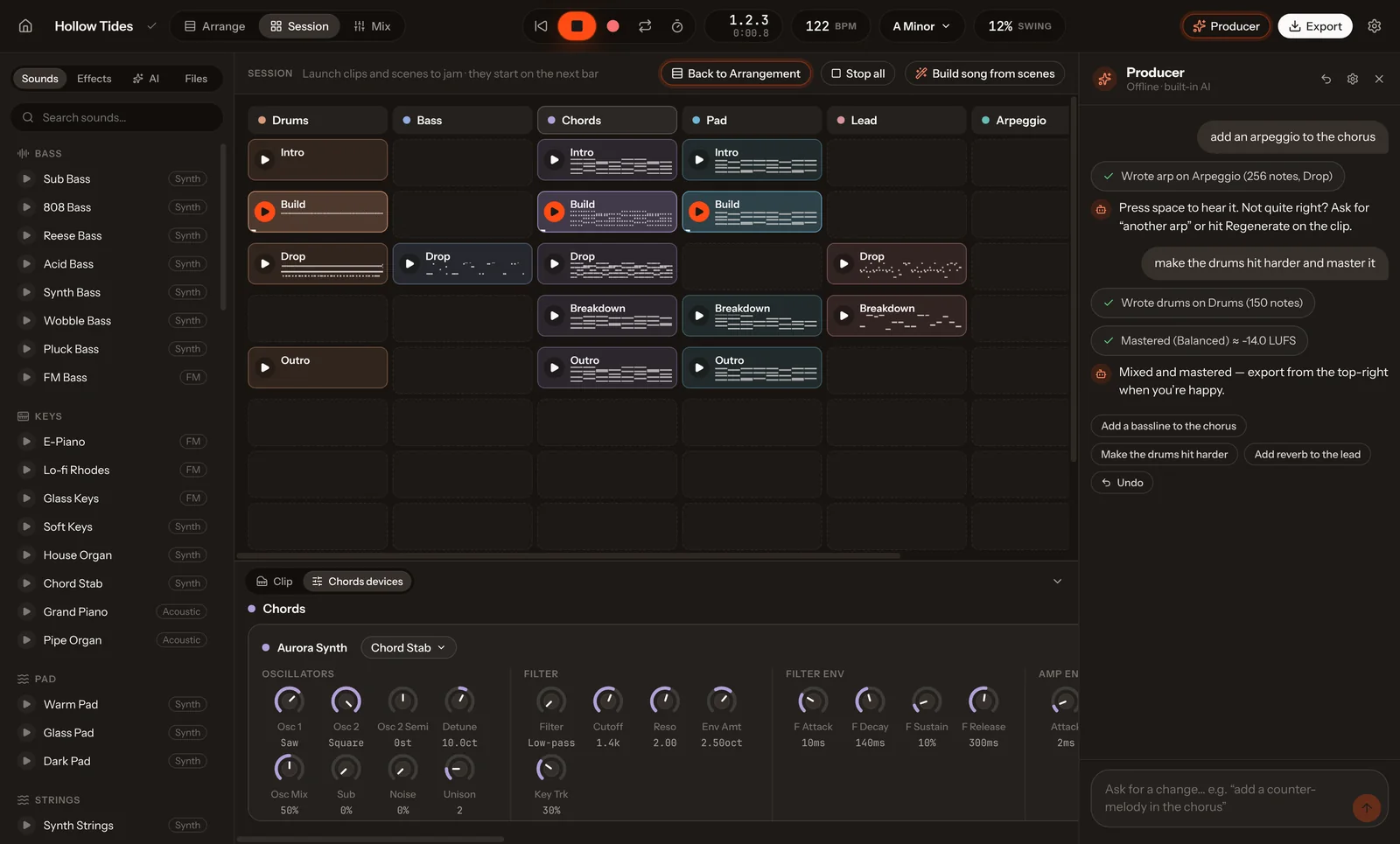
Session view
Session view: a grid of clips per track and scene, with scenes playing
Launch clips and scenes in time, then record them into the arrangement.
Piano roll
Piano roll with a melody, scale highlighting and MIDI tools
Scale-aware piano roll with 31 MIDI tools: humanize, harmonize, strum, arpeggiate, continue and more.
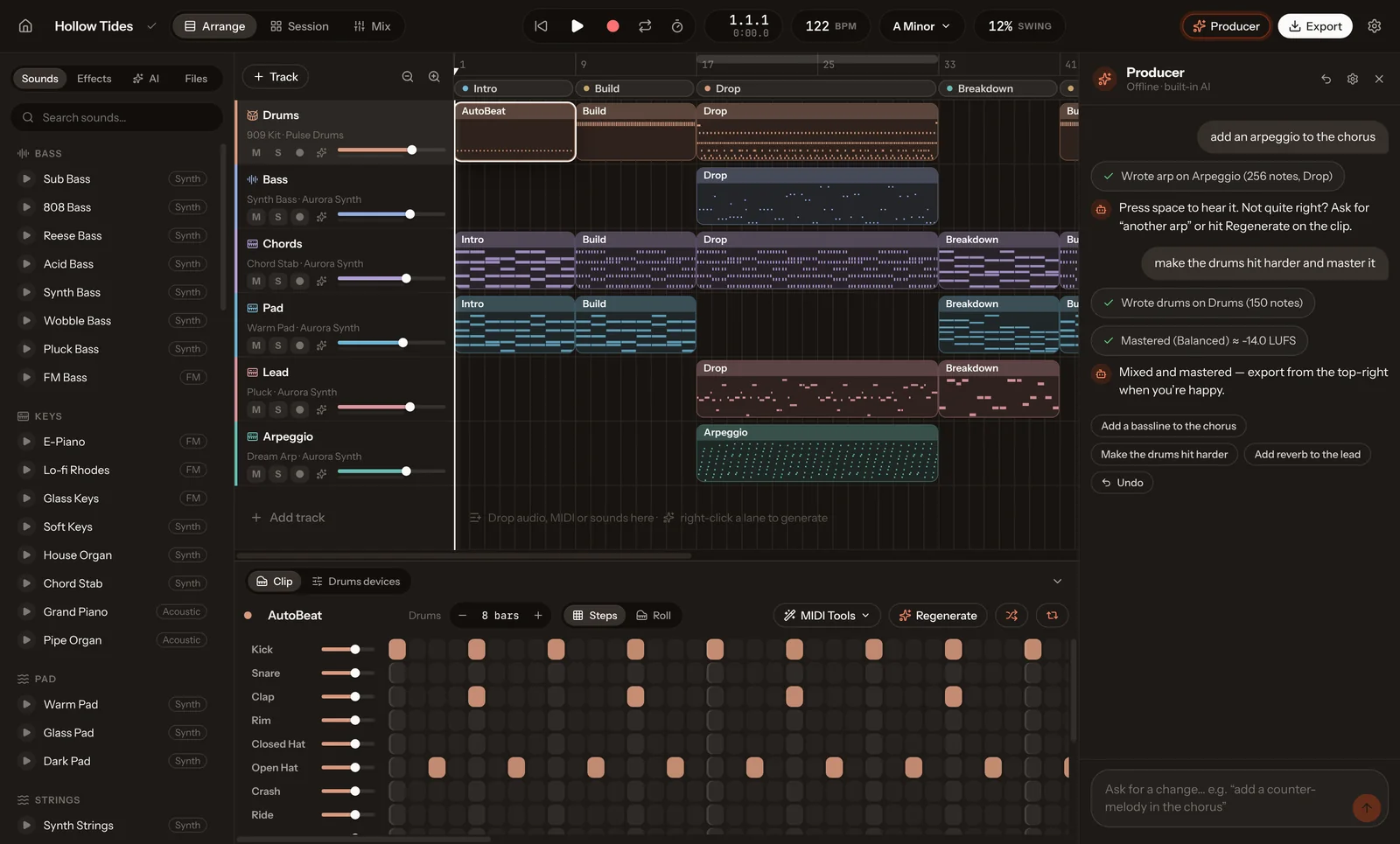
Drum sequencer
Drum step sequencer with kick, snare, clap and hat rows
Step sequencer with accents, ghosts and per-step chance.
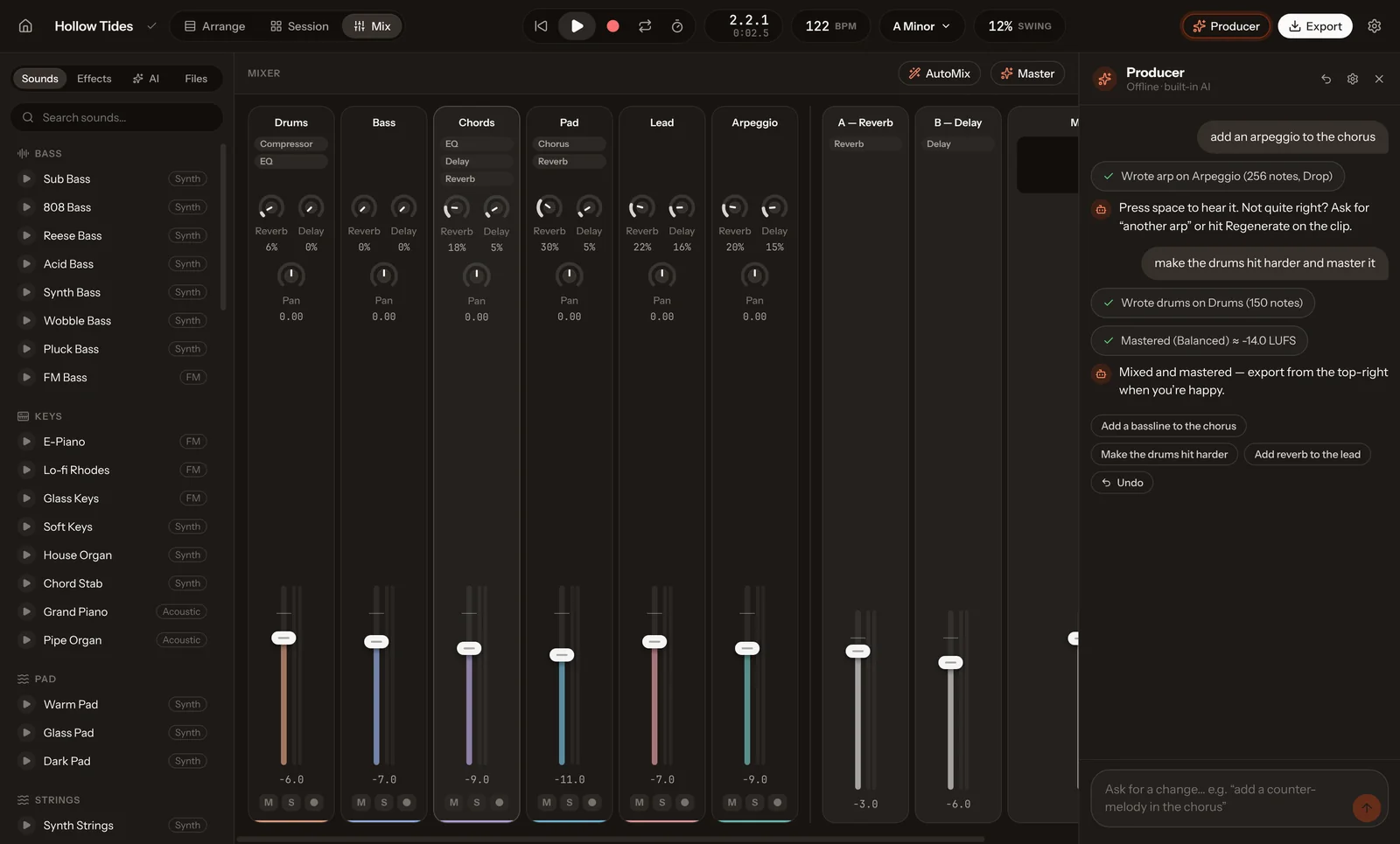
Mixer
Mixer with channel strips, sends and meters while the song plays
Mixer with sends, returns and a master chain. AutoMix balances it for you.

Everything in the studio

Recorded instruments

26 real instruments, from a concert grand to a full orchestra.

Multi-sampled recordings with dynamic layers, alternating takes and seamless sustains: grand piano, pipe organ, solo violin and string sections, harp, brass, woodwinds, timpani, mallets and an orchestral percussion kit. Strings switch between sustain, staccato, pizzicato and tremolo.

See the full list
Harbour Sunrise
Orchestral cue76 BPMD major
0:00 / 1:44
Letters Home
Piano ballad66 BPME♭ major
0:00 / 1:37
MCP server

Let Claude run the studio.

Moziko has a built-in Model Context Protocol server with 47 tools. Claude Desktop connects in one click; Claude Code with one command. Claude can compose, arrange, design sounds, mix and master, and then render the song and listen to it, or take a screenshot, to check its own work.

claude mcp add --scope user moziko -e ELECTRON_RUN_AS_NODE=1 -- \
  "/Applications/Moziko.app/Contents/MacOS/Moziko" \
  "/Applications/Moziko.app/Contents/Resources/mcp/moziko-mcp.cjs"
How the MCP server works
Claude Code at work
Moziko after an MCP session: an orchestral song with tool calls from Claude Code listed in the activity panel
Every tool call shows up in the app, tagged with the AI app that made it, and is one undo step.
Compare

How it compares.

Moziko sits between prompt-to-song generators and full DAWs. Here is the short version; each product has its own page with sources.

 MozikoBandLabAbleton Live 12SunoGarageBand
Price€2.95 for 7 days, then €49.90 / monthFree tierIntro $99, Standard $349, Suite $749FreeFree
Song from a text promptFull instrumental arrangement, all editableSongStarter makes song ideas from genre, mood, tempo and key,…No text-to-musicComplete songs from text and lyrics, up to 8 minutesNo
Generates sung vocalsNoNo vocal generationNoYes, its main strengthNo
Edit every notePiano roll, drum sequencer, 31 MIDI toolsMIDI editingPiano rollMIDI editing in Suno Studio 2.0Piano roll, up to 255 tracks
Stem separationYes, on your Mac: vocals, drums, bass, other, then rebuilt as…Splitter: vocals, drums, bass, guitar, piano, otherStem Separation in SuiteStem separation on paid plansNot in GarageBand
Works offlineYesNeeds an internet connectionYesNo, cloud generationYes
AI agent control (MCP)Built-in MCP server, 47 tools, can listen to its rendersNo official API or MCPNo official MCPNo official public API or MCPNo MCP or agent control

All comparisons

Yours

Yours to keep.

  • One plan, everything in it. The studio in your browser and on your Mac, the AI and the library: €2.95 for 7 days, then €49.90 / month. Cancel anytime.
  • Your songs follow you. Saved to your account in the browser, or on your Mac in the app; export WAV, stems, MIDI or a project file.
  • The music is yours. Release what you make; the sounds it uses are free to use.
  • Works offline. The studio, the composer and a built-in Producer need no internet; the AI that reads your ideas and Claude in the Producer use a connection.

What it doesn’t do (yet)

Moziko doesn’t generate sung vocals, it runs on macOS only, and it doesn’t host VST or Audio Unit plug-ins. It is ad-hoc signed rather than notarized, so the first launch needs one click in System Settings. How to open it

Questions

Questions people ask.

What does it cost?

Making your first song is on us. The Studio plan is €2.95 for 7 days, then €49.90 / month: the studio in your browser, the Mac app, the AI and every library download. Only want library downloads? The Library plan is €0.95 for 7 days, then €49.90 / month. Cancel from your account menu, and billing stops at once. See pricing

Do I need Claude or an API key?

No. Moziko’s AI is built in: it reads your song ideas and runs the Producer. Your own Anthropic API key is optional, and the MCP server lets Claude Desktop or Claude Code drive the app too.

Can I release the music I make?

Yes, what you make is yours. The orchestral, band and world instrument samples are CC0 or public domain and need no credit. The Grand Piano samples are licensed CC BY 3.0, so if a release uses the Grand Piano, crediting “Salamander Grand Piano by Alexander Holm” follows that license; the same goes for the Wurlitzer and Electric Grand with “E-Pianos by Greg Sullivan”, and for the Rock Drum Kit with “MuldjordKit by Lars Muldjord (DrumGizmo)” (CC BY 4.0). Details are on the credits page.

Does it make vocals?

No. Moziko writes and plays instrumental parts. You can record your own vocals onto an audio track, and it can turn a sung or played melody into MIDI.

Why does macOS block it the first time?

The app is ad-hoc signed, not notarized by Apple. Open System Settings → Privacy & Security, scroll to the message about Moziko and click Open Anyway. You only do this once.

Windows or Linux?

Use Moziko in your browser at moziko.co/app: the same studio, AI and instruments, on any computer with a recent Chrome, Edge, Firefox or Safari. The desktop app is for macOS.

Make something tonight.

Your first song is a minute away, in your browser.

Questions people ask

What is Moziko?

Moziko is a music studio for your browser and your Mac. You describe a song in a sentence and it writes a full multitrack arrangement (drums, bass, chords, pads, melody) on real instruments, then you edit it like any DAW: a piano roll, drum sequencer, synths, 26 recorded orchestral and acoustic instruments, effects, a mixer and mastering. An AI Producer makes changes you ask for in plain English.

How much does Moziko cost?

Your first song is on us: make one in your browser, no card needed. To keep going, the Studio plan is €2.95 for 7 days, then €49.90 / month, with the studio in your browser, the Mac app and every library download. The Library plan, for downloads only, is €0.95 for 7 days, then €49.90 / month. Cancel anytime from your account; billing stops at once.

Which computers does Moziko run on?

Any computer with a recent Chrome, Edge, Firefox or Safari, in the browser. The desktop app is for Macs with macOS 13 Ventura or later, both Apple silicon (M1 and later) and Intel.

Can I use the music I make in Moziko commercially?

Yes. Songs you make are yours, and the 10,000 songs in Moziko’s music library are royalty-free with no credit needed, for videos, games, podcasts, apps and commercial releases. The one sound with a credit request is the Grand Piano (CC BY 3.0); see the credits page.

How is Moziko different from Suno or Udio?

Suno and Udio generate a finished audio file. Moziko writes the song as editable notes played by its own instruments, so you can change any part, sound or note, and every AI change is one undo step. Moziko does not sing or generate vocals.

Can Claude use Moziko?

Yes. Moziko has a built-in MCP server with 47 tools, so Claude Desktop, Claude Code and other MCP apps can compose, arrange, mix, master and export songs, and listen to their own renders to check the result.

Does my music leave my Mac?

Your projects and audio stay on your Mac. When you create a song from an idea, the text of the idea is sent to Moziko’s AI to plan it, and Producer requests send your message with a compact summary of the song. You can turn the AI off in Settings to keep everything local.
Showcase

Made in Moziko.

19 tracks, about 32 minutes of music, made entirely inside the app. Claude composed them through Moziko’s MCP server, listened to its own renders and fixed what it heard. Open “How it was made” on any track to see how it was built.

19tracks
19styles
0outside samples or loops
−14LUFS loudness target
Neon Run
Synthwave100 BPMA minor
0:00 / 1:58
How it was made

Over MCP, from a create_song draft, starting from the prompt “night drive synthwave with gated drums, pulsing analog bass, shimmering arps and a soaring lead”.

  1. create_song with the prompt (synthwave, 100 BPM, A minor)
  2. write_chords: Am F C G for intro and verse with an octave bassline; F G Am F G C E as stabs in the chorus; Fmaj7 G Em7 Am in the breakdown
  3. create_clip: an 8-bar lead hook that climbs to E6
  4. add_effect EQ on the chords (high-pass 160 Hz, −2.5 dB at 350 Hz), chords −2 dB, lead +1.5 dB to bring the hook forward
  5. master punchy; export

Listening: A final “hook forward” pass: an EQ cut on the chords and a small level swap brought the lead in front, checked with analyze_audio before the punchy master.

909 KitSynth BassAnalog BrassWarm PadSynthwave LeadDream Arp
Last Train Home
UK garage132 BPMF minor
0:00 / 2:13
How it was made

Over MCP, from a create_song draft, starting from the prompt “late night UK garage 2-step with organ stabs, deep sub bass and chopped plucks”.

  1. create_song with the prompt (132 BPM, F minor), swing 0.6
  2. set_instrument: Chord Stab; write_chords Fm9 Bbm9 Eb9 Abmaj7 as pads, offbeat upstrokes and stabs by section, an 8-chord drop progression ending C7sus4 C7
  3. create_clip: 2-step drum grids per section (skipping kick, clap, hats, ghosted shaker, rim) and quantize
  4. create_clip: a syncopated sub bass with octave bounces following the drop chords
  5. create_clip: a pluck “vocal chop” motif over the drops; generate_part a sparse melody for the breakdown
  6. master; export
909 KitSub BassChord StabWarm PadPluck
Afterglow
Liquid drum & bass174 BPMC minor
0:00 / 1:42
How it was made

Over MCP, from a create_song draft, starting from the prompt “euphoric liquid drum and bass with warm pads, rolling breaks, deep sub and a bell melody”.

  1. create_song with the prompt (drum & bass, 174 BPM, C minor)
  2. set_instrument: Sub Bass (distortion removed), Glass Pad chords, a string pad; add a Dream Arp track
  3. write_chords Abmaj9 Bb6 Gm7 Cm9: pads in intro and breakdown, 1/16 arpeggios in the builds, pads with a roots bassline in the drops
  4. generate_part: an arp in each drop
  5. create_clip: a 16-bar bell hook for the drops, a softer copy in the breakdown
  6. add_effect: dotted-quarter ping-pong delay on the lead, plus reverb send; master; export
Acoustic KitSub BassGlass PadSynth StringsBellDream Arp
Glass Cathedral
Melodic Techno124 BPMD minor
0:00 / 1:43
How it was made

Made by Claude over MCP.

  1. new_project “Glass Cathedral”, 124 BPM, D minor; set_sections Intro 8 · Rise 8 · Peak 8 · Breakdown 8 · Return 16 · Outro 4
  2. add_track ×9 on Techno Kit, Synth Bass, Dream Arp, Supersaw Lead, Dark Pad, Synth Strings and a noise riser
  3. set_instrument: plucky rolling-bass envelope; a slow 0.08 Hz LFO on the arp filter; strings with 2.6 s amp and 3.5 s filter attack for the swell
  4. create_clip: four-on-the-floor with 16th hats, syncopated rims, toms and a 4-bar snare roll into the return
  5. create_clip: rolling 16th bassline off the kick (e-and-a) over Dm – Bbmaj7 – Gm9 – A7sus4, two bars per chord
  6. create_clip: arpeggio that evolves from a 3-note 8th cycle to 5- and 7-note 16th cycles, so the accents drift against the bar
  7. create_clip: lead theme introduced in the breakdown over the string swell, then doubled in length on the return
  8. analyze_audio: kick buried and bass sub-heavy (its −12 st oscillator reached ~24 Hz) → kick +3 dB, octave oscillator removed, bass +4 dB, lead +6 dB
  9. analyze_audio: kick now sub-heavy → tuned it up 2 st with a −2.5 dB low shelf at 55 Hz
  10. analyze_audio: 500 Hz build-up in the breakdown from the strings → EQ −6 dB at 500 Hz, +2 dB air
  11. master punchy, export −14 LUFS

Listening: The first render of the return measured −16.6 LUFS, sub-heavy, with the kick 2 dB under the string swell and the lead at −37 LUFS; after rebalancing it measured −12.9 LUFS with no findings. A 500 Hz low-mid bump in the breakdown (+4.1 dB) was cut on the strings; only the intended “thin low end” of the kick-less breakdown remains.

Techno KitSynth BassDream ArpSupersaw LeadDark PadSynth StringsWarm Pad (noise riser)
Monsoon Circuit
Drum & Bass174 BPMF minor
0:00 / 1:36
How it was made

Made by Claude over MCP.

  1. new_project “Monsoon Circuit”, 174 BPM, F minor; set_sections Intro 16 · Build 8 · Drop 16 · Breakdown 8 · Drop 2 16 · Outro 4
  2. add_track: a 909 “Beat” bus, an Acoustic Kit “Break” layer, Reese Bass + Sub Bass, Dark Pad, FM Bell motif, Pluck stabs, noise riser
  3. set_instrument: Reese with 22-cent detune, 3-voice unison and a slow filter LFO; add_effect saturator + chorus on it, 6 s reverb on the pad
  4. create_clip: two-step beat (kick 1 & the and-of-3, snare 2 & 4, ghost snares, tom fills) under an Amen-style break layer high-passed at 320 Hz
  5. create_clip: atmospheric intro — Fm9 – Dbmaj7 – Bbm9 – Cm7 pad with the break fading in at bar 9 and a dotted-8th-delayed bell motif
  6. create_clip: two-bar reese phrases with octave flicks and fifth/third pickups, doubled by the sub; a variation in Drop 2
  7. create_clip: off-beat pluck stabs answering the snare, snare rolls and risers into each drop
  8. analyze_audio found the drum bus 14 dB over the reese and the pad bed louder than the motif → beat −3 dB, reese +9 dB, pad −3 dB, break/stabs/motif up
  9. analyze_audio: breakdown dominated by the snare roll → softer roll velocities
  10. master punchy, export −14 LUFS

Listening: The first drop render measured −11.1 LUFS with the drum bus at −20 LUFS and the reese at −34.5 LUFS (no band of its own); after rebalancing the drums and reese sat within 2 dB of each other and analyze_audio reported no problems. In the breakdown the snare roll read 9 dB over the motif and was softened.

909 KitAcoustic KitReese BassSub BassDark PadBellPluckWarm Pad (noise riser)
Paper Satellites
Future Bass150 BPMEb major
0:00 / 1:45
How it was made

Made by Claude over MCP.

  1. new_project “Paper Satellites”, 150 BPM, Eb major; set_sections Intro · Verse · Build · Drop 16 · Breakdown · Build 2 · Drop 2 · Outro (64 bars)
  2. add_track: Trap Kit (kick on its own track), Sub Bass, Supersaw chords, Grand Piano, Supersaw lead, FM Bell, Glass Pad, noise riser
  3. set_instrument: 7-voice supersaw with an 85 ms attack so every chord hit re-swells after the kick (sidechain-style pump)
  4. create_clip: Abmaj9 – Bbadd9 – Cm9 – Eb/G | Abmaj9 – Bbadd9 – Cm9 – Fm9 Bbsus4 as syncopated supersaw chops
  5. create_clip: an 8-bar lead hook, doubled two octaves up on the bell and an octave down on the Grand Piano in Drop 2
  6. create_clip: half-time drums (kick 1 + the and-of-3, clap+snare on 3, triplet hat rolls), a doubling snare roll into each drop
  7. duplicate_track: split the chords into Saws L / Saws R panned ±0.75 with different detune after analyze_audio reported a nearly mono drop (corr 1.0)
  8. analyze_audio: chords buried (−35.8 LUFS) and sub-heavy → chords +5 dB per side, sub −2 dB, kick +3 dB, lead +6 dB
  9. analyze_audio: build louder than the drop and a 500 Hz piano build-up in the breakdown → softer roll and saw pulses, piano EQ −3.5 dB at 450 Hz
  10. master punchy, export −14 LUFS

Listening: The first drop render read −16.9 LUFS, nearly mono (correlation 1.0) and sub-heavy, with the chords at −35.8 LUFS; after splitting the chords into a wide L/R pair and rebalancing, it read −14.4 LUFS at correlation 0.92 with no warnings. The build was louder than the drop and the breakdown had a +4.3 dB piano bump at 500 Hz; both were fixed.

Trap KitSub BassSupersaw Lead (chords, ×2)Supersaw Lead (mono lead)Grand PianoBellGlass PadWarm Pad (noise riser)
Saltwater Postcards
Tropical House112 BPMA major
0:00 / 1:45
How it was made

Made by Claude over MCP.

  1. new_project “Saltwater Postcards”, 112 BPM, A major; set_sections Intro · Verse · Pre-Chorus · Drop · Break · Pre-Chorus 2 · Drop 2 · Outro (48 bars)
  2. add_track: recorded Concert Marimba, Flute and Grand Piano alongside a 909 kick/tops, Afro Kit percussion, Pluck Bass, Pluck chords and Warm Pad
  3. create_clip: Dmaj7 – A/C# – F#m7 – Esus4 E loop; Bm7 – C#m7 – Dmaj7 – E lift for the pre-chorus
  4. create_clip: marimba hook on a tresillo 16th rhythm (x..x..x.x.x.x.x.) whose contour follows the chords; Flute doubles it in Drop 2
  5. create_clip: flute topline for the verse, syncopated piano comping, bouncy root–fifth–octave Pluck Bass, off-beat Pluck chords with an auto-pan tremolo
  6. create_clip: congas, clave and shaker groove; clap rolls and risers in each pre-chorus
  7. analyze_audio: the recorded marimba read −19.5 LUFS (12 dB over the kick) with a +6.5 dB build-up at 500 Hz → marimba −10 dB and EQ −3 dB at 500 Hz; kick, bass, tops and perc raised
  8. analyze_audio: piano mud at 500 Hz and flute harshness at 2 kHz in the verse → EQ −4 dB at 450 Hz on the piano, −4.5 dB at 1.8 kHz on the flute
  9. analyze_audio: drop no louder than the verse → hook, chords and pad lifted 2–3.5 dB, piano eased
  10. analyze_audio: break still bright at 1–2 kHz → flute down an octave, perc −3.5 dB at 2 kHz; delete_clips moved a misplaced hook and riser
  11. master punchy, export −14 LUFS

Listening: The first drop render read −12 LUFS with the recorded marimba 12 dB over the kick and a +6.5 dB low-mid bump at 500 Hz; after rebalancing, the drop measured −14.9 LUFS (about 2 dB over the verse) with no findings. Verse and break warnings (piano mud, flute and conga brightness around 1–2 kHz) were cleared with EQ and by moving the break flute down an octave.

Concert MarimbaFluteGrand Piano909 KitAfro KitPluck BassPluckWarm PadWarm Pad (noise riser)
Smoke & Satin
Deep House122 BPMA minor
0:00 / 1:45
How it was made

Made by Claude over MCP.

  1. new_project at 122 BPM in A minor (titled with set_song); set_sections Intro 8 · Groove 8 · Drop 16 · Breakdown 8 · Drop 2 8 · Outro 4
  2. add_track ×9: separate Kick, Tops and Perc drum tracks (909 + Afro kits), Sub Bass, Chord Stab, Pluck, E-Piano, Warm Pad, a noise riser
  3. set_instrument: turned the Pluck into a band-passed, gliding mono “vocal chop”; noise riser with a 4 s filter sweep
  4. create_clip: drum grids with hand-placed shuffle (off-16ths late by ~20 ms), conga/clave groove, clap roll into Drop 2
  5. create_clip: Am9 – Dm9 – Fmaj9 – Em11 as rootless stabs (x..x..x....x..x.), last stab pushing the next chord
  6. create_clip: off-beat rolling sub with 16th ghost notes and octave flicks
  7. create_clip: two-cell chop hook sequenced down the progression; E-Piano plays it an octave down in the breakdown
  8. analyze_audio found the kick buried and the sub too heavy → kick +6 dB, F/E bass roots up an octave, stabs −1 dB with EQ −3 dB at 350 Hz
  9. analyze_audio found the hook 15 dB under the stabs → opened its band-pass and lifted it 11 dB in two passes
  10. analyze_audio found a 500 Hz build-up in the breakdown → EQ −3.5 dB at 500 Hz on the E-Piano, −2.5 dB on the pad, hook moved up an octave
  11. master punchy, export −14 LUFS

Listening: First pass: the drop measured −16.9 LUFS with the kick 4 dB under the bass, the chop hook at −46 LUFS and a sub-heavy warning; after rebalancing it measured −14.1 LUFS with no findings. The breakdown flagged a +5 dB low-mid bump at 500 Hz from the E-Piano, cleared with EQ cuts and by moving its hook up an octave.

909 KitAfro KitSub BassChord StabPluck (band-pass chop)E-PianoWarm PadWarm Pad (noise riser)
Rain on Fourth Street
Lo-fi hip hop78 BPMD minor
0:00 / 2:06
How it was made

Over MCP, from a create_song draft, starting from the prompt “rainy night lofi hip hop with dusty rhodes, soft flute lead and vinyl warmth”.

  1. create_song with the prompt (lofi, 78 BPM, D minor)
  2. set_instrument: Lo-fi Rhodes on the chords
  3. write_chords Gm9 C9 Fmaj9 Dm9: a pad in the intro, block chords with a roots bassline in the verses, strummed in the hooks
  4. write_chords: the same progression on the pad, low register
  5. master warm; analyze_harmony on the hook to check every note sits in key; export
Lo-fi KitSub BassLo-fi RhodesWarm PadSoft Lead
Obsidian Hours
Trap142 BPMF minor
0:00 / 1:30
How it was made

Made by Claude over MCP, starting from the prompt “dark trap with eerie bells, hard 808 glides and rolling hi-hats”.

  1. create_song “dark trap with eerie bells, hard 808 glides and rolling hi-hats”, short form, then set_sections to Intro 8 · Hook 16 · Verse 8 · Hook 2 16 · Outro 4 and cleared the generated clips
  2. write_chords: Fm – Dbmaj7 – Bbm – C (harmonic-minor V) on Dark Pad, two bars each
  3. create_clip: 8-bar bell hook in 3-3-2 rhythm that lands on E natural over the C chord
  4. add_track Grand Piano: the same motif an octave down plays the intro alone, then doubles the bells in Hook 2
  5. set_instrument 808 Bass: glide 0.09 s, decay 2.2 s, drive 0.32, pitch punch 14 st; 808 line follows the kick and slides into each new root
  6. create_clip drums by hand: half-time snare+clap, 8th hats with 1/16-triplet, 1/32 and triplet-8th rolls every second bar, open hats in Hook 2
  7. analyze_audio on Hook 2: bells 7 dB under the drums and 'sub-heavy' → bells +7 dB, piano +5 dB, kick low shelf 2.5→0.5 dB, 30 Hz high-pass on 808 and kick
  8. analyze_audio flagged a +4.3 dB low-mid bump at 500 Hz → EQ cuts on bells (−3.5 dB @ 450 Hz), piano (−3 dB @ 400 Hz) and pad (−2 dB @ 350 Hz)
  9. master punchy, 808 −1.5 dB more, export −14 LUFS

Listening: First pass of Hook 2 had the bells at −26 LUFS against −19 for the drums and a sub-heavy warning; after the level moves the bells sit at −19 LUFS, then a +4.3 dB low-mid bump at 500 Hz went down to +2.9 dB with three EQ cuts, and Hook 2 came back with 'no obvious problems'.

Trap Kit808 BassBellGrand PianoDark Pad
Velvet Window
Neo-Soul86 BPMEb major
0:00 / 1:32
How it was made

Made by Claude over MCP, starting from the prompt “neo-soul with rhodes chords, upright bass and a lazy swung groove”.

  1. create_song “neo-soul with rhodes chords, upright bass and a lazy swung groove”, then set_song swing 58 % and set_sections Intro 4 · A 8 · B 8 · A' 8 · Outro 4
  2. create_clip: hand-voiced rootless E-Piano chords — Fm9 · Bb13 · Ebmaj9 · Cm9 · Gm11–C7#9 · Fm9–Bb7b9 — rolled in the intro, pushed comping in the A sections
  3. set_instrument Double Bass Pizzicato: walking/syncopated line with chromatic approach notes into every chord
  4. set_instrument Soft Lead (glide 0.06 s, light vibrato): a lyrical 8-bar melody, embellished the second time
  5. B section for contrast: half-time drums with ride and a tom fill, Grand Piano sings the high line, String Ensemble pad enters (write_chords)
  6. create_clip step grids on the Acoustic Kit: ghost snares, 16th hat pushes, open hat and ride in A'
  7. analyze_audio on A': lead under the bass, strings at −36 LUFS, +3.9 dB build-up at 500 Hz → lead +5 dB, Rhodes EQ (−2.5 dB @ 420 Hz) + chorus, strings EQ'd and up 6 dB
  8. The 500 Hz bump came from the lead's own register → lead EQ dip, master switched from warm to balanced, and transform_clip transposed the A' melody up an octave for the peak, which cleared A'
  9. export −14 LUFS

Listening: First pass of A' put the lead (−26.8 LUFS) under the upright bass and flagged a +3.9 dB build-up at 500 Hz; after level and EQ moves, plus taking the A' melody up an octave, A' reads 'no obvious problems' with the lead on top at −19.2 LUFS. The first A section keeps a milder 500 Hz lift from the low melody, on purpose.

Acoustic KitE-PianoDouble Bass PizzicatoSoft LeadGrand PianoString Ensemble
Lekki Sundown
Afrobeats105 BPMD major
0:00 / 1:34
How it was made

Made by Claude over MCP, starting from the prompt “bouncy afrobeats with log drum bass, marimba hook and warm rhodes chords”.

  1. create_song “bouncy afrobeats with log drum bass, marimba hook and warm rhodes chords”, then set_song swing 14 % and set_sections Intro 4 · Verse 8 · Hook 8 · Bridge 8 · Hook 2 8 · Outro 4
  2. set_instrument: turned the Sub Bass into a log drum (square overtone, 9-semitone pitch drop, 0.42 s decay, drive 0.3)
  3. create_clip: Gmaj9 – A6/9 – F#m7 – Bm9 on E-Piano, hand-voiced around a held F#4, sustained in the intro, comping in the verse, syncopated stabs in the hooks
  4. create_clip: 8-bar Concert Marimba hook in off-beat 16th pickups, answered by a Kalimba counter-figure in Hook 2
  5. create_clip drum step grids on the Afro Kit: 3-3-4 rim, accented 16th shaker, conga calls, claps and hats only in the hooks, cowbell for the peak
  6. Bridge for contrast: kick and clap drop out, the log drum goes sparse and a recorded Flute sings a long line over sustained Rhodes
  7. analyze_audio: log drum at −30 LUFS under −22 drums, kalimba/pad inaudible, 500 Hz build-up and a 'nearly mono' verse → log drum +7 dB, Rhodes chorus + pan, marimba EQ dip at 520 Hz, widePad chain on the pad
  8. Second listen: Rhodes was louder than the hook → Rhodes −3.5 dB, marimba +2.5 dB, flute and kalimba up
  9. master punchy, export −14 LUFS

Listening: First pass of Hook 2 measured the log drum at −30 LUFS against −22 for the drums, flagged a +4.8 dB build-up at 500 Hz and called the verse nearly mono; after the level, EQ and chorus moves every section reported 'no obvious problems' with the marimba hook on top (−18.5 LUFS) and the flute leading the bridge.

Afro KitSub Bass (log drum design)E-PianoConcert MarimbaKalimbaFluteWarm Pad
Luna de Neón
Reggaeton95 BPMG minor
0:00 / 1:44
How it was made

Made by Claude over MCP, starting from the prompt “reggaeton perreo with dembow drums, catchy pluck hook and dark minor chords”.

  1. create_song “reggaeton perreo with dembow drums, catchy pluck hook and dark minor chords”, then set_sections Intro 4 · Verse 8 · Pre 4 · Hook 8 · Break 4 · Hook 2 8 · Outro 4
  2. create_clip: Gm – Eb – Cm – D (harmonic-minor V) as Glass Keys stabs on the dembow off-beats
  3. set_instrument Pluck: 3-voice unison, 1.3 kHz cutoff, 3.6-octave filter envelope; create_clip 8-bar hook in 3-3-2 phrasing that resolves through F# to G
  4. create_clip step grids on the 808 Kit: four-on-the-floor kick with the …x..x....x..x. dembow snare, ghost claps, 16th-hat pushes, tom fills in Hook 2
  5. create_clip: Sub Bass locked to the kick with ‘and-a’ pickups; held roots in the Pre build while the snare rolls from quarters to 16ths
  6. add_track Dream Arp (verse and Hook 2) and Bell doubling the hook an octave up in Hook 2; Warm Pad with the widePad chain in the Pre, Break and Hook 2
  7. analyze_audio on Hook 2: sub-heavy 808 kick at −18.9 LUFS burying the hook (−29.5) and a nearly mono image → kick decay 0.6×, drum EQ −1.5 dB low shelf, pluck +7 dB with longer decay, keys panned left with chorus, arp right
  8. Second listen: keys louder than the hook and a 250 Hz build-up in the verse → keys −4.5 dB plus EQ (high-pass 180 Hz, −2.5 dB @ 280 Hz), lead EQ dip at 500 Hz
  9. master punchy, export −14 LUFS

Listening: First pass of Hook 2 was sub-heavy, with the 808 kick at −18.9 LUFS and the pluck hook buried at −29.5 LUFS in a nearly mono mix; after the kick, level, pan and EQ moves the hook leads at −20.3 LUFS over the drums and bass (−21.9) and Hook 2 reports 'no obvious problems'.

808 KitSub BassGlass KeysPluckDream ArpBellWarm Pad
Lanterns Under Snow
Ambient72 BPMD major (lydian colour)
0:00 / 1:36
How it was made

Made by Claude over MCP, starting from the prompt “slow evolving ambient with glass pads, harp and a distant violin”.

  1. create_song “slow evolving ambient with glass pads, harp and a distant violin”, removed the drums, set_sections Opening 8 · Drift 8 · Bloom 8 · Fade 4
  2. create_clip: hand-voiced pads — Dmaj9 · E/D (the lydian II-over-I shimmer) · Bm11 · Gmaj9, two bars each, then one chord per bar in the Bloom
  3. set_instrument: Warm Pad with slow 0.07 Hz filter LFO and 2.2 s attack, Glass Pad with amplitude LFO and 5 s release, widePad chain and chorus
  4. Harp ripples (8ths in the Drift, 16ths in the Bloom) through a dotted-quarter ping-pong delay; Glockenspiel lights; return reverb stretched to 7.5 s
  5. Solo Violin: a distant three-note call in the Drift, then the full 8-bar song in the Bloom, ending on a held F#5 over a final Dmaj9 with a G# glint
  6. analyze_audio: harp at −18.6 LUFS dominating, the Drift's violin at −40.7 LUFS, 500 Hz build-up of +8.5 dB → harp −5 dB with EQ (high-pass 180 Hz, −3 dB @ 450 Hz), violin up, Warm/Glass Pad EQ dips; removed doubled chorus/reverb inserts left from create_song's chains
  7. Drift read dark (presence −33 dB, air −42 dB) → glockenspiel lights in the Drift, +3 dB high shelf on the Glass Pad, a soft sub drone underneath
  8. master balanced measured on the Bloom (section renamed 'Drop' for the measurement, then back), limiter +1.4 dB so the export reaches −14 LUFS without hitting the peak cap

Listening: First pass: harp at −18.6 LUFS over everything, the Drift's violin call at −40.7 LUFS, and a +8.5 dB low-mid bump at 500 Hz in the Drift. After the fixes the violin leads the Bloom, the Drift's bump fell to +4.7 dB with presence up from −33 to −22 dB, and the remaining mild 500 Hz lift was left alone because it is the body of the harp and pads.

Warm PadGlass PadHarpSolo ViolinGlockenspielSub Bass
Harbour Sunrise
Orchestral cue76 BPMD major
0:00 / 1:44
How it was made

Composed note by note over MCP.

  1. new_project “Harbour Sunrise”, 76 BPM, D major; set_sections Intro 4 · Theme 8 · Rise 8 · Climax 8 · Coda 4
  2. One batch of add_track: String Ensemble, Double Bass, Cello Section Pizzicato, French Horn, Violin Section, Flute, Harp, Brass Section, Glockenspiel, Timpani, Timpani Roll and the Orchestral Percussion kit
  3. write_chords for each section, style pad, swelling from velocity 64 to 100
  4. create_clip: the French horn theme, the violin melody for the rise and climax, a flute call and answer
  5. create_clip: rippling harp eighths and pizzicato cellos under the rise
  6. create_clip: a timpani roll that builds into the climax and a cymbal swell timed to peak on its downbeat, then crashes and a soft gong
  7. analyze_audio per track: low-mid buildup near 500 Hz and a harsh 2 kHz in the climax → EQ cuts on strings, brass and violins
  8. Horn up 4 dB, harp down 3 dB so the theme leads; master balanced; export

Listening: analyze_audio flagged a +6 dB low-mid buildup and forward high-mids in the climax, and per-track loudness showed the harp louder than the horn theme. EQ cuts and a 4 dB horn lift fixed both.

String EnsembleDouble BassCello Section PizzicatoFrench HornViolin SectionFluteHarpBrass SectionGlockenspielTimpaniOrchestral Percussion
Andante for Strings
Chamber strings72 BPMG major
0:00 / 1:29
How it was made

Composed note by note over MCP.

  1. new_project, 72 BPM, G major; sections A 8 · B 8 · A′ 8
  2. add_track: Solo Violin, Violin Section, Viola Section, Cello Section, Double Bass Pizzicato
  3. create_clip: the solo violin line, shaped bar by bar with velocity
  4. create_clip: second violins and violas voice-led chord to chord, pulsing in quarter notes in the B section
  5. create_clip: a cello bass line, and plucked double bass from bar 9
  6. analyze_harmony read the chords back and caught the double bass playing 8 bars late (bars 17–20 came back as Em7 Bm Cmaj7 C); fixed and re-checked
  7. analyze_audio per section → accompaniment up 3 dB under the soloist; master balanced; export

Listening: analyze_harmony exposed a bass part offset by eight bars. After the fix the chords read back as written, with 0 notes outside the key.

Solo ViolinViolin SectionViola SectionCello SectionDouble Bass Pizzicato
Letters Home
Piano ballad66 BPME♭ major
0:00 / 1:37
How it was made

Composed note by note over MCP.

  1. new_project, 66 BPM, E♭ major; sections Intro 4 · Verse 8 · Chorus 8 · Outro 4
  2. add_track: Grand Piano, Cello Section, String Ensemble, Solo Violin
  3. create_clip: piano left hand (bass and fifths) and right-hand broken chords in eighths, lightly humanized
  4. create_clip: the cello melody for verse and chorus, ending on a borrowed minor iv (A♭m)
  5. write_chords: a soft string pad under the chorus and outro
  6. create_clip: a solo violin counter-line in the chorus
  7. analyze_audio per section: strings buried 11 dB under the piano → strings +6 dB, cello +2 dB; master balanced; export

Listening: Per-track loudness showed the strings far below the piano and the cello only level with its accompaniment; two fader moves put the melody on top.

Grand PianoCello SectionString EnsembleSolo Violin
Cutlass at Dawn
Adventure Score100 BPMD minor
0:00 / 1:34
How it was made

Composed note by note in Moziko by Claude, starting from the prompt “a swashbuckling pirate-adventure theme: galloping 6/8 strings in D minor, heroic horns, brass stabs and timpani, building to a full-orchestra climax”.

  1. New song at 100 BPM in D minor, each beat a dotted quarter so everything gallops in triplet eighths; sections Intro 4 · Theme 8 · Theme 2 · 8 · Storm 8 · Climax 8 · Ending 2
  2. Cello Section Staccato and Double Bass Staccato: a non-stop galloping ostinato on the chord roots (Dm – Bb – F – C – Dm – Gm – A – Dm), the cellos alone in the Intro and crescendoing in
  3. French Horn: an original heroic theme over the gallop; Trombone doubles it an octave down from Theme 2, Violin Section takes it an octave up, and the Climax puts all three together
  4. Viola Section Staccato and Trumpet Staccato: chord stabs on the off dotted-quarters; Violin Section Tremolo shimmering under the first Theme and the Climax
  5. Storm: Trombone and Tuba Staccato growl a call on Gm and Dm, String Ensemble Staccato answers with rising arpeggios, a snare roll and a Timpani Roll on A pull into the Climax
  6. Timpani on the chord roots with pickups, Orchestral Percussion bass drum, galloping snare, crashes, a cymbal swell into the Climax and a gong on the last chord
  7. Ending: two A7 hits and a final D minor chord for the whole orchestra, no fade; mastered with Punchy to −12 LUFS

Listening: The gallop never stops: cellos and basses hammer triplet eighths under every section, so the theme, the brass stabs and the timpani pickups all ride the same 6/8 swing, and the orchestra keeps adding layers until the two A7 hits and the final D minor chord.

Cello Section StaccatoDouble Bass StaccatoViola Section StaccatoFrench HornTromboneTuba StaccatoTrumpet StaccatoViolin SectionViolin Section TremoloString Ensemble StaccatoTimpaniTimpani RollOrchestral Percussion
Iron Meridian
Hybrid Cinematic Trailer90 BPMD minor
0:00 / 1:28
How it was made

Made by Claude over MCP, starting from the prompt “epic hybrid trailer with orchestral percussion, staccato strings, brass stabs and a growling reese bass”.

  1. create_song “epic hybrid trailer with orchestral percussion, staccato strings, brass stabs and a growling reese bass” (genre cinematic), kept the percussion, strings, violins, pad and bass, deleted the harp, set_sections Intro 4 · Build 8 · Rise 8 · Peak 8 · Hit 4
  2. set_instrument String Ensemble {articulation: Staccato}: a 16th pedal-D ostinato over Dm – Bb – Gm – A, crescendo across Build and Rise
  3. add_track Brass Section ×2: Staccato stabs in 3-3-2 rhythm from the Rise, and a sustained 8-bar theme in the Peak doubled an octave up by the Violin Section
  4. Orchestral Percussion by hand: bass drum and timpani 1–5 patterns, a snare 16th→32nd roll, and cymbal swells placed 5¼ beats early so they crest on the downbeat (timed with a test render)
  5. Low end: Cello Section and Double Bass roots, Reese Bass with drive, and a Sub Bass turned into a pitch-drop 'boom' for the section hits
  6. Rise tension: Violin Section Tremolo climbing D5→E6 and a Timpani Roll crescendo; one beat of silence before the final tutti D, gong and crash
  7. analyze_audio: brass stabs peaking +2.7 dBFS pre-master and burying the theme, reese/sub at −33…−36 LUFS → stabs −8 dB with a fast compressor, theme +6 dB, reese +9 dB with an EQ, sub +6 dB
  8. Second listen: 2 kHz harshness → theme −2.5 dB @ 2.2 kHz, violins −2 dB shelf; final chord thinned with edit_notes; theme EQ'd −2.5 dB @ 420 Hz
  9. master measured the intro because no section was called chorus/drop/hook → renamed Peak to 'Drop' with edit_section, mastered punchy, renamed it back; export −14 LUFS

Listening: First pass of the Peak had the staccato brass at −18.6 LUFS (peaking +2.7 dBFS pre-master) over a −25.8 LUFS theme, with the reese and sub nearly inaudible; after the fixes the theme leads the Peak at −20.5 LUFS, the Peak reads 'no obvious problems', and re-mastering against the Peak instead of the intro moved the limiter from +1.2 dB to −3.3 dB, so the track builds from −13 LUFS (Rise) to −11.7 (Peak) to a final hit that peaks at −10.1 LUFS short-term (pre-normalization).

Orchestral PercussionString Ensemble StaccatoBrass Section StaccatoBrass SectionViolin SectionViolin Section TremoloCello SectionDouble BassTimpani RollReese BassSub BassDark PadGrand Piano
How these were made

No hidden steps.

Every track started in Moziko and never left it. Most began with create_song and a one-line prompt, then Claude rewrote the chords, wrote its own hooks and drum patterns, changed sounds and effects, and arranged the sections. The orchestral and piano pieces were composed note by note.

Before each export Claude rendered the song with analyze_audio to check loudness, balance and spectrum, and with analyze_harmony to check the chords, then fixed what it found. Mastering used Moziko’s own chain. The MP3s here are 160 kbps and matched to −14 LUFS so you can compare them fairly.

The sounds are Moziko’s synths, drum machines and recorded instruments. There are no sample packs, loops or stems from anywhere else.

Make your own

Paste any prompt from these tracks into Moziko’s home screen to get a draft in the same style, or ask Claude to take it further with the produce_song prompt in the MCP server.

Download Moziko